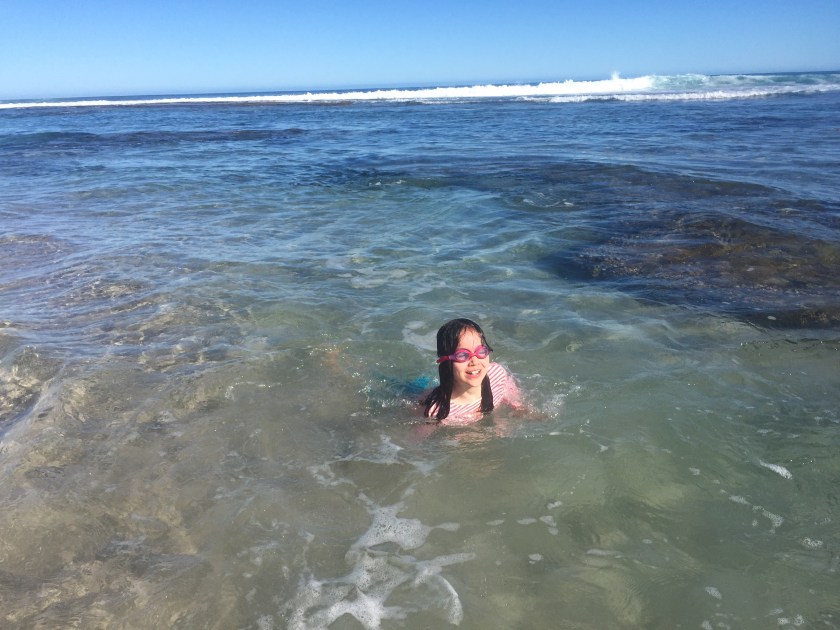
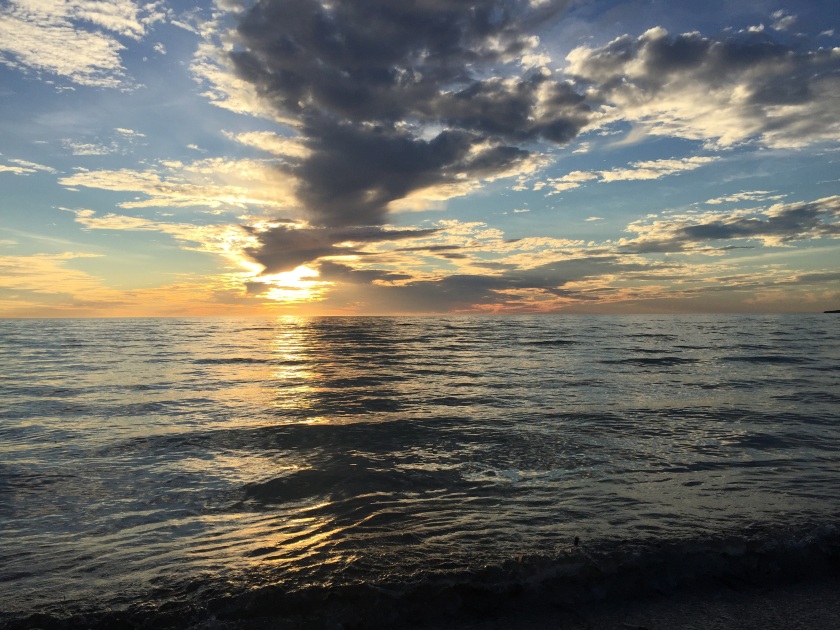
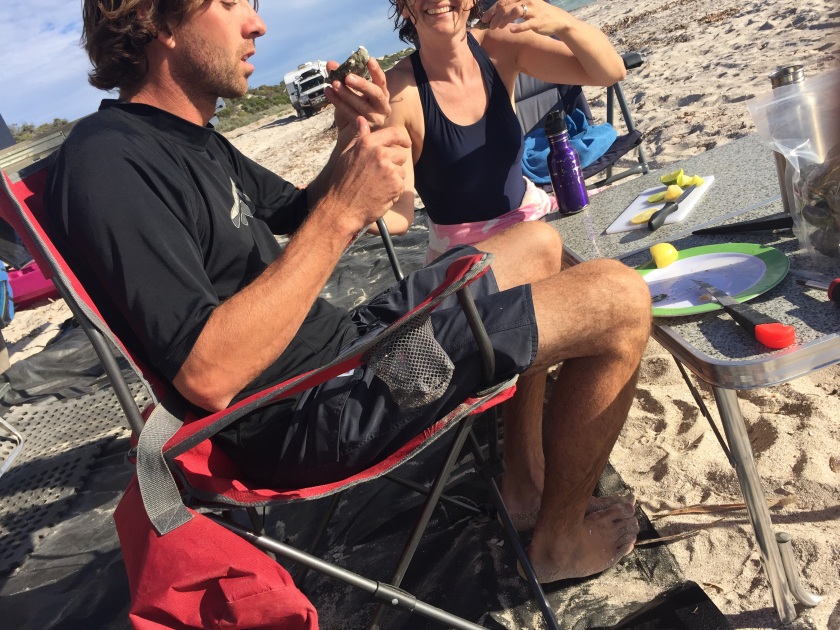
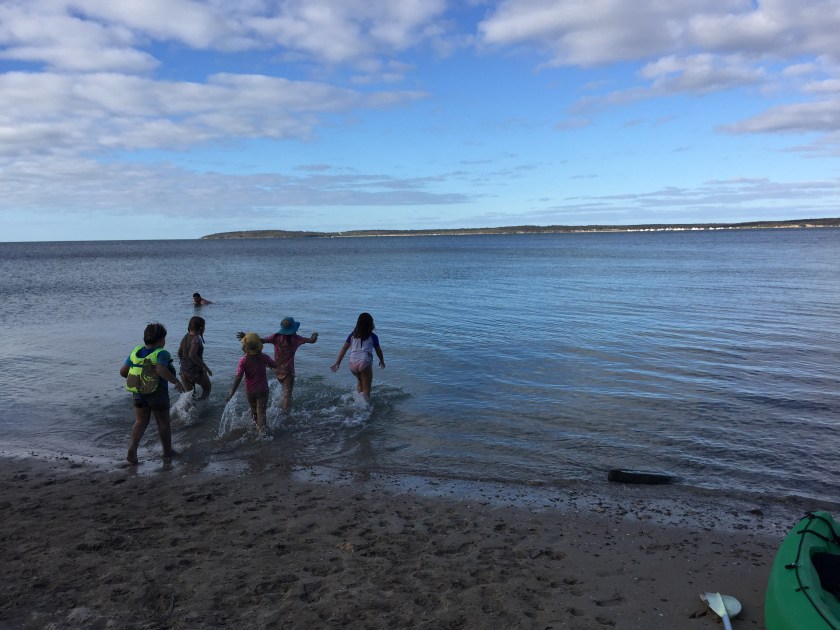
At the start of the week we found ourselves just north of Geraldton at a stunning little campsite, Coronation Beach, where K and I went for a sunset swim (see above left).
As soon as the sun plops down into that vast Indian Ocean, however, the temperatures drop and it gets down to 8 or 9 degrees at night. Burrrr (see R, above right).
After two nights near Gero, where we got to see remnants of the infamous Batavia shipwreck, we drove to Kalbarri. Here we’re staying three nights at Murchison House Station, right on the river. Lee was lucky enough to pick up some work. The girls and I have been checking out the gorges at the local National Park (HOT) and snorkelling at Blue Holes (refreshing).
Nature’s Window, Kalbarri National Park
Tomorrow we head north again, not sure where . . .
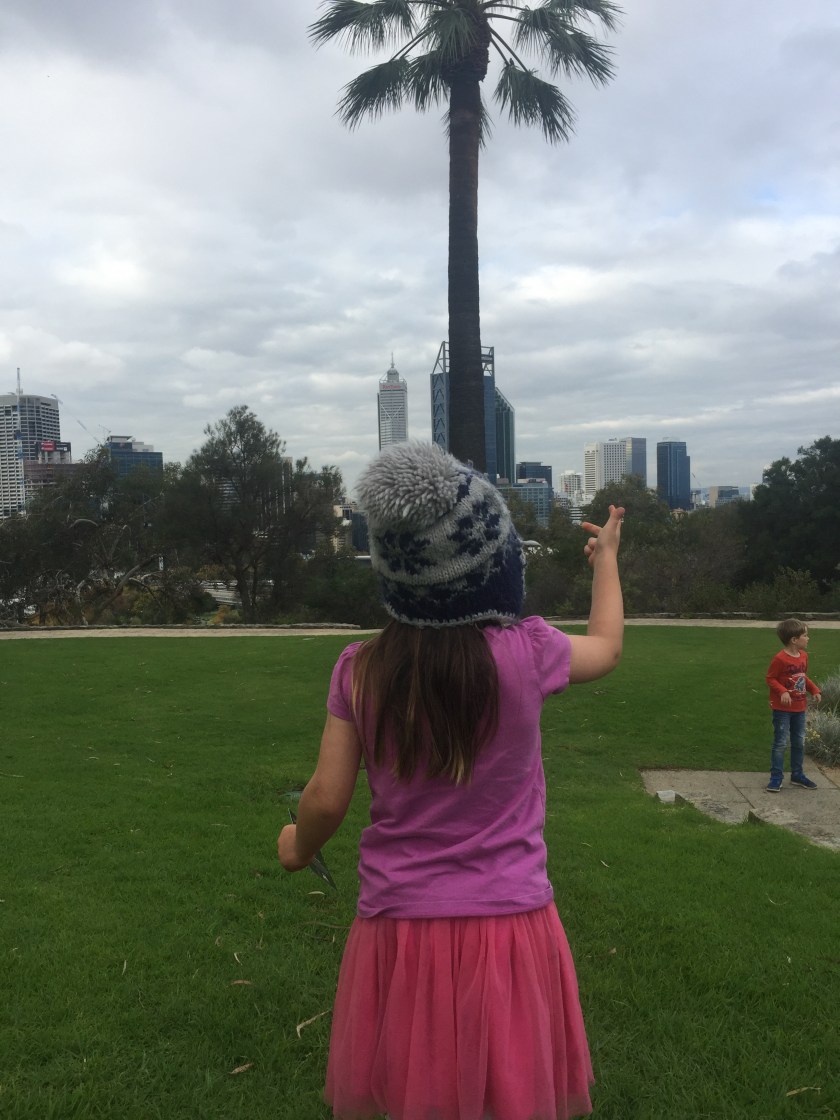
R counting (in Auslan) the buildings on the Perth skyline
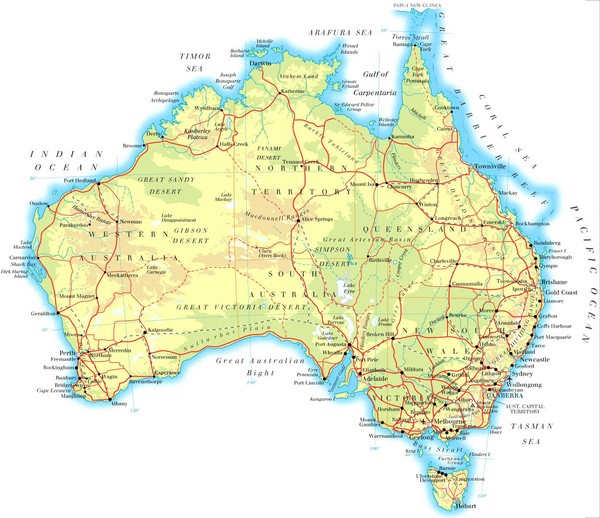
With a population under 2 million, Perth is hardly a rat race. But it’s the last city we’ll see until we get to Brisbane (on the other side of this continent) which is 9, 227 kms away, via the top end. Knowing us, we’ll take an extra ten thousand kms to get there. We’ve already driven nearly 20, 000 kms from Sydney to Perth.
We paused in Perth for two weeks so K could attend Mosmon Park School for the Deaf. She loved it! “So many of the teachers are deaf!” she told me enthusiastically after her first day of school, “and they have three playgrounds!” Like Klemzig, the school she visited in South Australia, Mosmon Park had Auslan Language Role Models in the classroom, along with the teacher, which is an excellent addition to any classroom with deaf signing students. Not only are these deaf adults an excellent language model, they’re also a great role model. Unlike Klemzig, Mosman Park had a separate classroom for deaf students.
K loved both schools, but I suspect the integrated model at Klemzig—where hearing and deaf were in the same class, but everyone signed—was more challenging for the deaf students.
That said, the staff at this Perth school were fabulous, and K had an amazing experience. She even suggested we move to Perth.
Both schools that K has visited in Adelaide and Perth were much more laid-back than her school in Sydney, but I think that reflects the different cities, more than anything.
Perth is a lovely lazy city with pretty beaches and an excellent art gallery in the city. People say, “hi” when you pass them on the street and, as one teacher from MP, who’d moved here from Sydney told me, “Everyone drives like it’s Sunday afternoon.”
Lee found it hard to pick up work. It seems that all the carpenters have come back from the FIFO (fly in, fly out) mining jobs. Mining’s slowing down, and everyone’s looking for work. And Perth is expensive! It’ll be good to get back to the Bush, where there’s nothing to buy.
Grass tree at Avon Valley National Park
Last weekend we camped in the Perth Hills at Avon Valley National Park, which was full of what R calls “poof trees”. They remind me of Truffula trees in The Lorax. And they are, in fact, grass trees that live to be up to 600 years, maybe more. It’s hard to calculate their age. They are, obviously, slow-growing, and more like a “woody plant”. The trunk takes ten years to grow.
We said goodbye to Perth on Friday after school and hit traffic, not getting to our campsite until well after dark. Lee set up in the dark. I cooked a late dinner and put the girls to bed at 9.30. It rained all night and all the next morning when we were packing away. I could hear the mildew on the canvas cheering gleefully as we packed away.
On the road again . . .
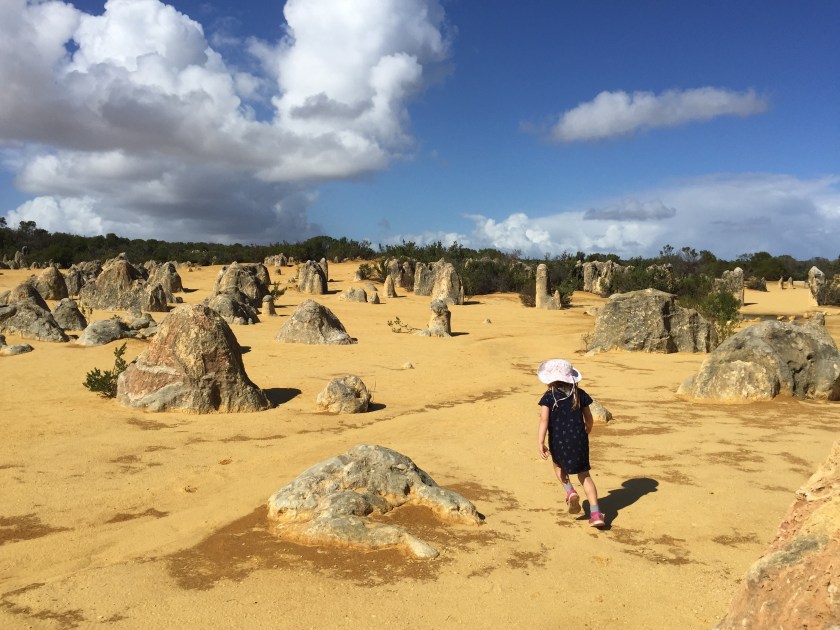
On Saturday we drove to the very touristy Pinnacles, took two photos, then came to Jurien Bay, on the aptly named Turquoise Coast for Mother’s Day weekend.
R running round the Pinnacles National ParkJurien Bay, WA
In the southwest of Western Australia near Manjimup, among the apple orchards and tall trees, lies Fonty’s Pool, otherwise known as “the fountain of youth”. It’s “half an acre of fresh spring water”. The trees were changing and you could feel autumn in the air. K and R and I spent a whole day in and out of the pool.
Our two nights at Fonty’s pool–there’s an adjacent caravan park–were cold. We slept with hot water bottles, long underwear, fleeces and beanies.
On our last morning it was about 14 degrees outside and K and I enjoyed the pool to ourselves.
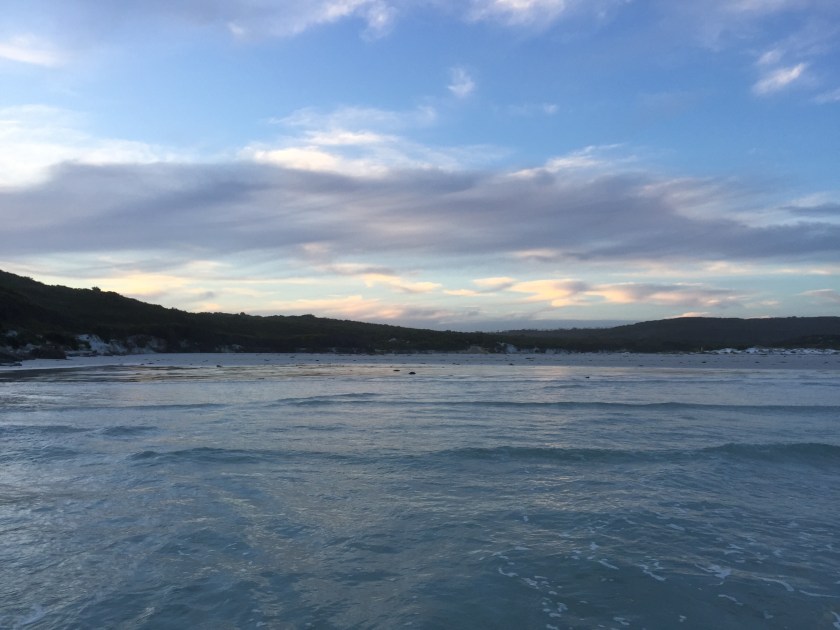
Sunset at Hamelin Bay
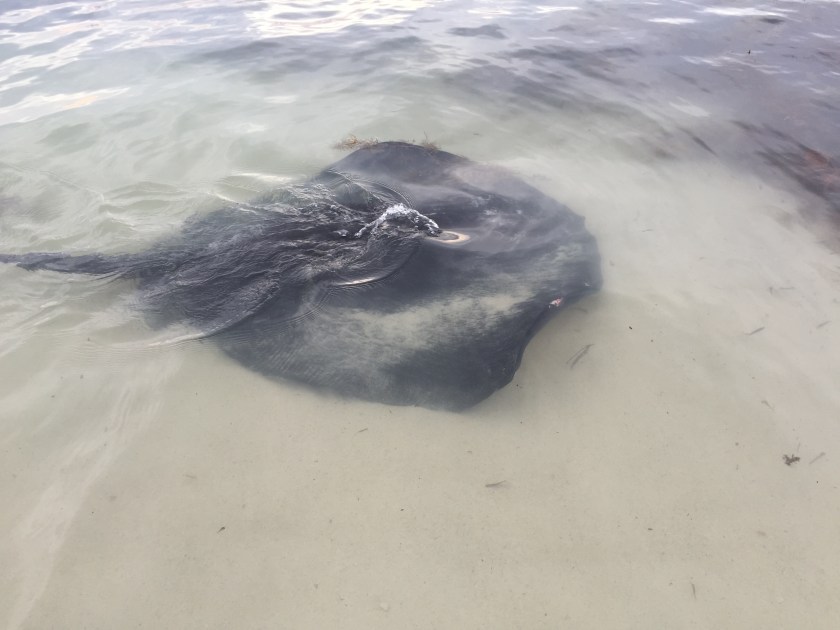
Next stop: Hamelin Bay, home to some friendly stingrays.
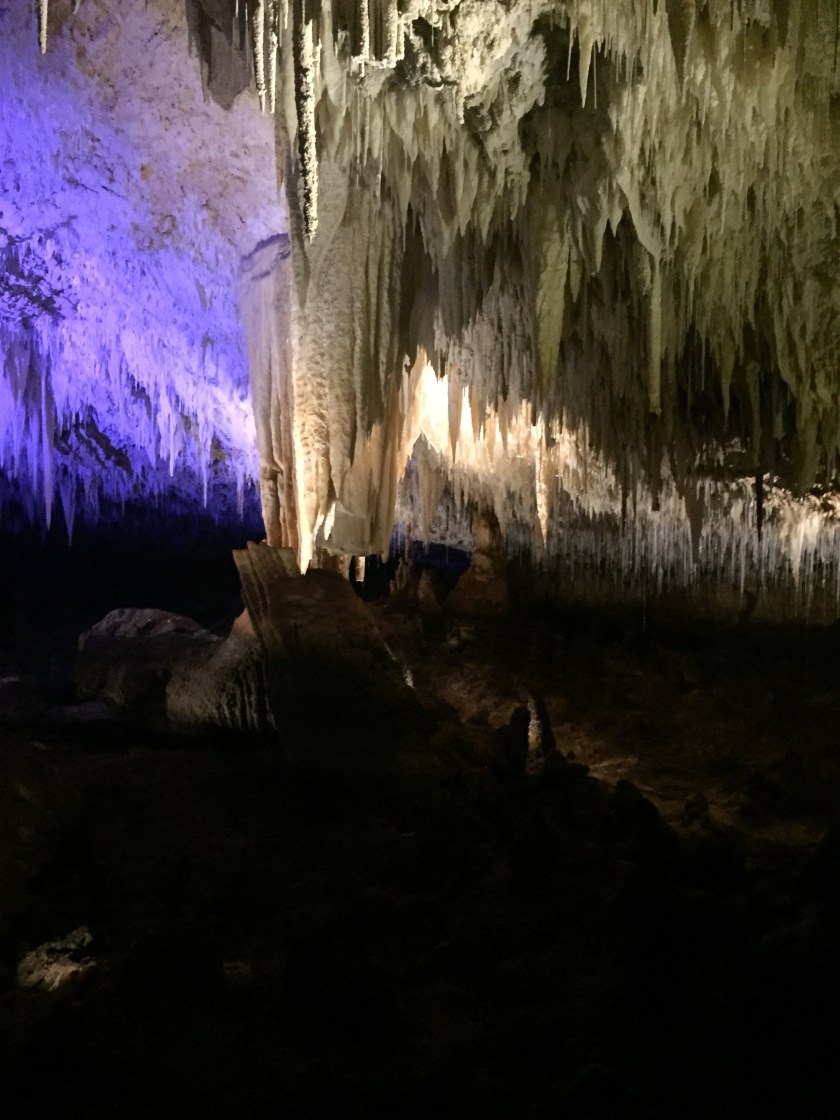
Inside Jewel Cave
Lee took the girls to one of the many caves and let me do part of the Cape to Cape trek one day–an arduous walk with stunning sea views–10 k was enough for me.
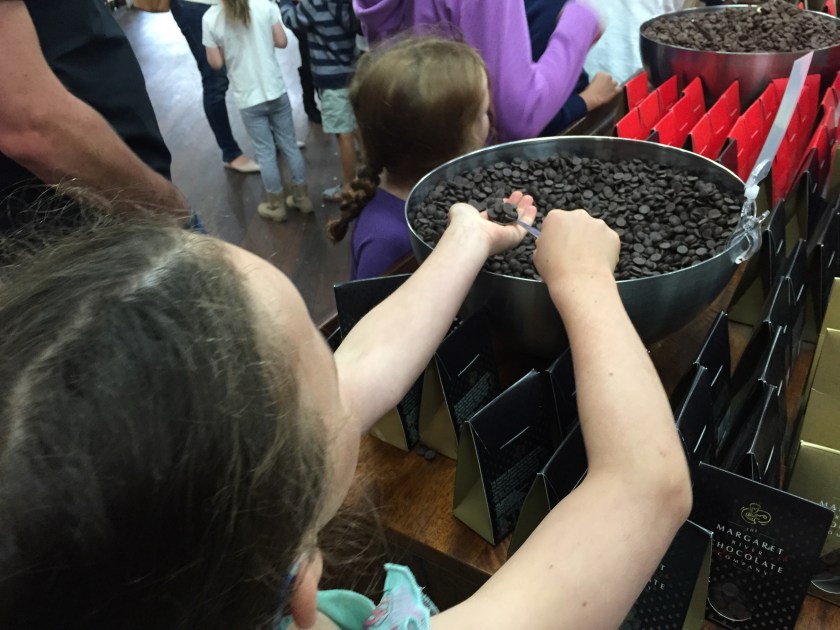
K helping herself at the Margaret River Chocolate Factory
We couldn’t resist the famed wineries and chocolate factory at Margaret River, home to 150 wineries. I showed great restraint (and respect for our budget) and visited just one. The girls enjoyed free samples at the chocolate factory.
We stayed the night with Lee’s friends from Wales, Suzanne and Kev, in their beautiful house in Busselton. Ah, to be indoors!
Next stop, Perth. K will go to a local deaf school for two weeks and Lee will look for work.
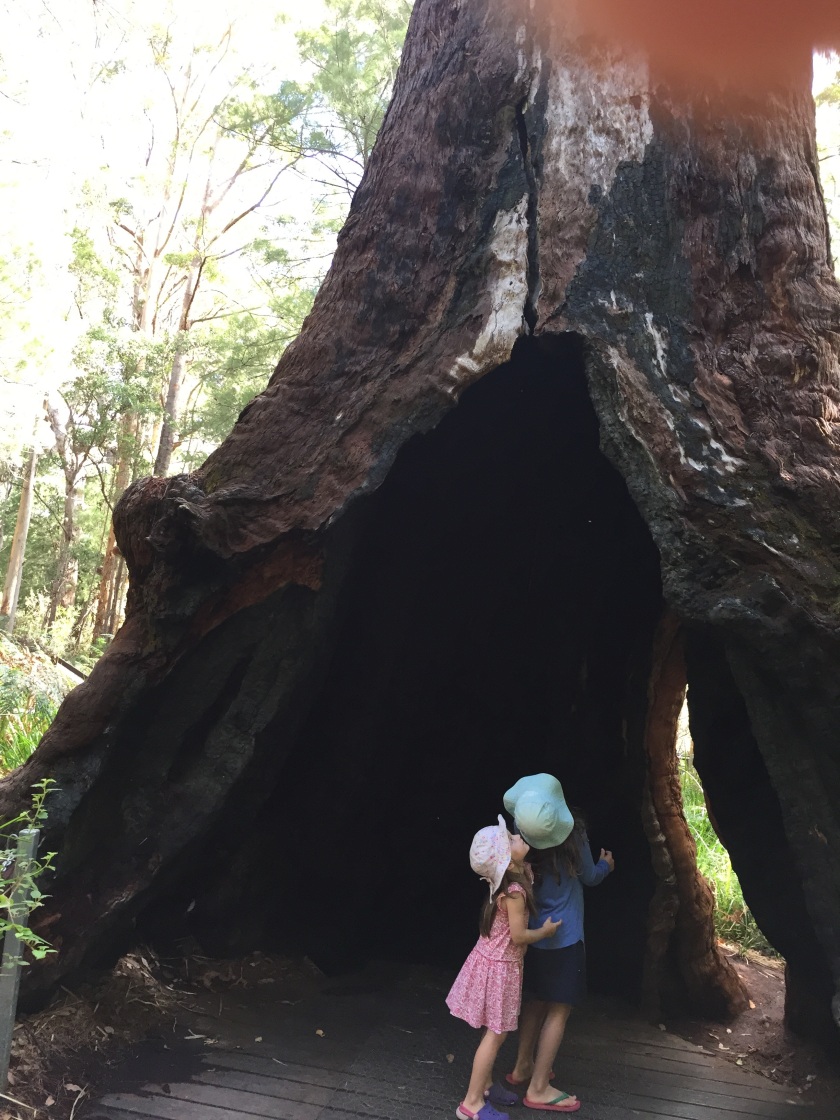
Walpole is home to the rare towering tingle trees that sound like something from Roald Dahl (recall the “tinkle tinkle tree” in The Giraffe, the Pelly and Me). But they’re very real, these giant red tingles that grow up to 75 metres high.
R and K inside a tingle
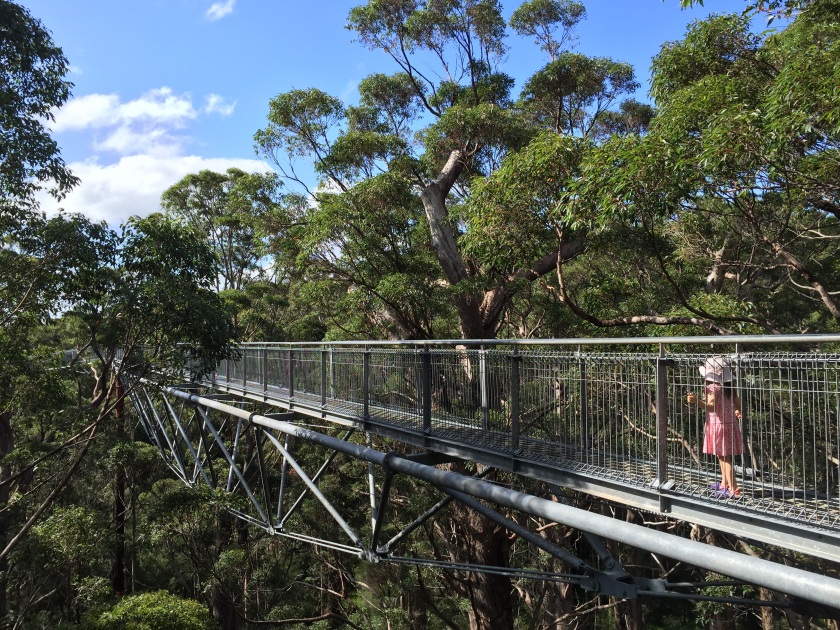
The tingles, which can live 400 years, have a girth of up to 24 metres. The bottom of these giants are sometimes hollowed out and, in the 1960s, tourists used to drive through them. This played havoc with the shallow root system, however; these days we take better care of our tingles.R among the tingles–Treetop Walk
We camped in D’Entrecasteaux National Park for three days, at Crystal Springs, a magical little forest camp in among (much smaller) moss-covered trees and bull banksia. Next to our camp was the dirt road to Mandalay Beach–8 k that I walked to in the rain.
Stunning and treacherous coastline not far from the big trees: Mandalay Beach, home to yet another shipwreck
It rained and rained and we all played Uno. R made puppets. K read the second Harry Potter five times. When the rain eased off K pretended to be a witch and R was her owl, bringing messages through the trees (practicing writing without me having to ask!)
After three days under the trees in the rain, we had to get going—no solar power for the fridge. Mould growing on canvas—yikes!
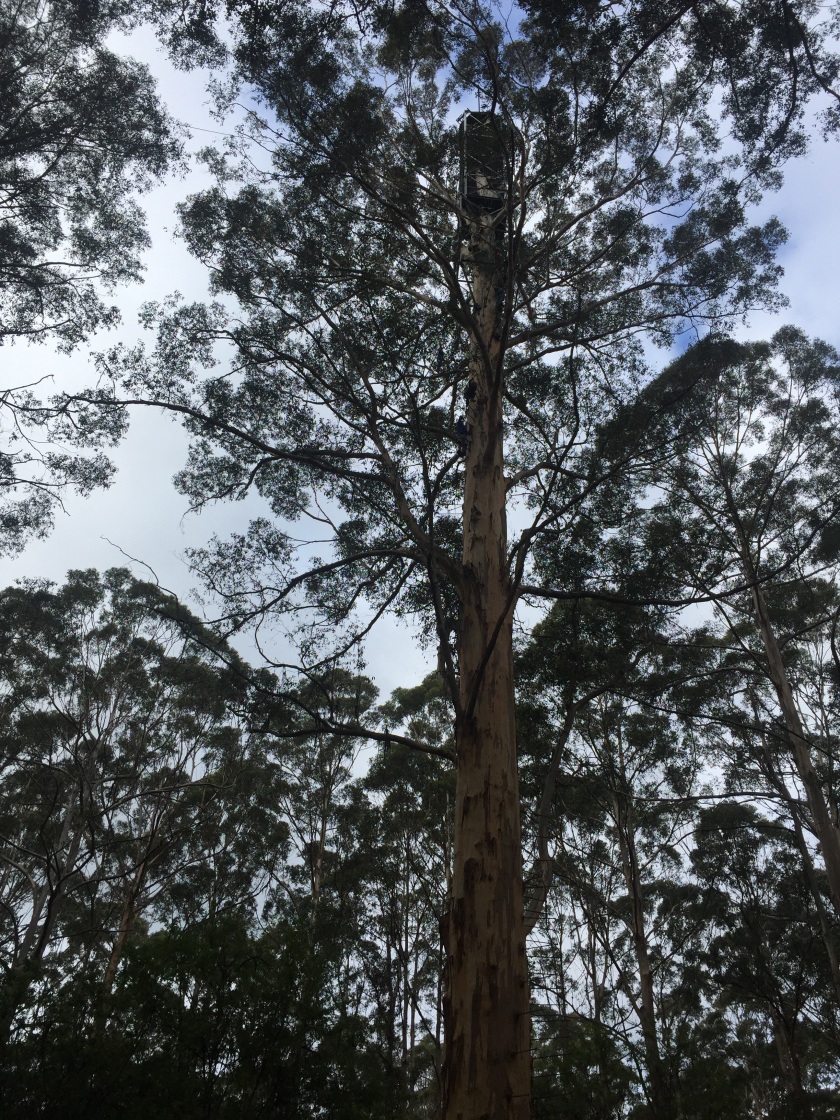
We drove to the Gloucester Tree, a karri, 53 metres high. In 1934, this was chosen as a fire look-out and they hammered metal pylons into the side of the tree all the way up. You can still climb to the top with nothing but bits of metal to hold onto. I cannot believe that this is still legal.
Gloucester Tree, WA
When we arrived, K sped up the tree in no time. I climbed slowly after her, trying not to look down, methodically placing one foot above the next, and gripping those little metal bars tightly.
About halfway up, I wished I’d stayed on the ground.
Looking down from the Gloucester Tree–from njhurst.com
But I kept climbing. K, having reached the top, started coming down again. “No, go back,” I said. So she went back and waited for her old mum. I’ve never been so scared. There’s nothing between you and the ground. But I made it! And the view, looking out over the green tops of all those giant trees, was peaceful and serene.
We went down and Lee had a go. K climbed went up a second time. This time, near the top, she let her feet dangle and swung from one of the pylons. “You’re giving me a heart attack!” I signed. She laughed.
Then she put her feet down and started signing back to me. “Don’t sign!” I said. She just smiled, and scurried down, as if she was climbing the smallest ladder.
Surprisingly, no one has ever fallen off the Gloucester Tree, but there have been two heart attacks at the top.
We left Cape Arid and the friends we’d made there and headed west to Esperance, to a caravan park, where we ran into the friends from Cape Arid. (This often happens.)
In Esperance, K and I did home school at the bakery. Then we visited the museum, which had, among other treasures, the remains of a U.S. space station that NASA lost control of; it crashed to earth in 1979. Bits of it were found scattered on sheep stations and the like in Esperance and the surrounding Goldfields.
The museum displayed numerous old things from decades gone by, including a tiny shack set up in the way the “pioneers” lived in the 1800s, complete with bed and billycan and not a lot else. It reminded me of the way we’re living now, except we don’t have to start a fire to boil the billy; we’ve got gas. And we have three bikes, two scooters, one unicycle, two boogie boards, two surf boards, a newly purchased purple kayak and a good deal more time for leisure.
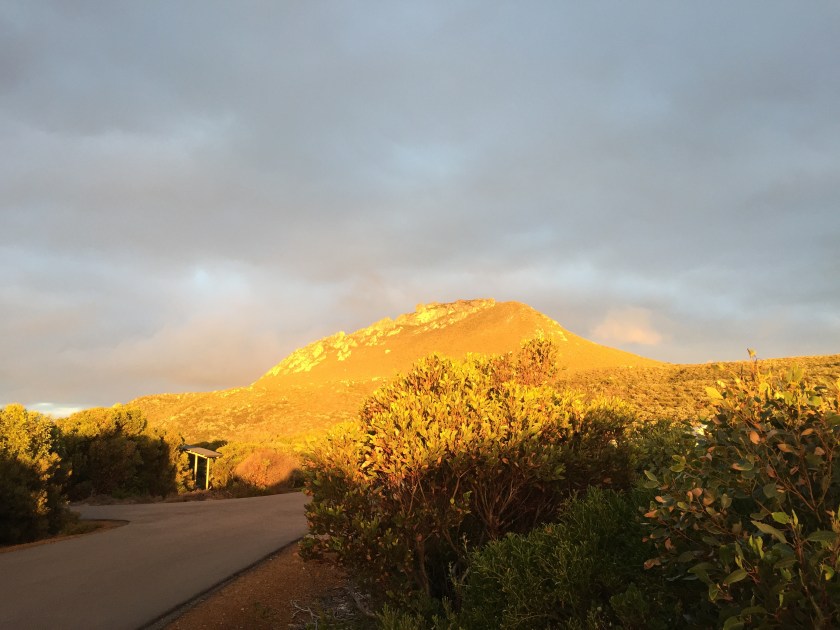
Mount Brenner, viewed from our campsite in Fitzgerald River National Park
K and I climbed Mount Brenner–a steep beautiful walk. We saw 38 lizards. At the summit, we scrambled to the very top of the mountain that afforded glorious views in all directions of coast, granite rocks, beaches and mountains.
The next day rain came and we packed up a wet tent and drove 232 kilometres to Denmark.
Denmark is green and blessed with a river, rolling hills, stunning beaches, inlets and a fabulous bookshop. I could’ve stay forever, except that we were in a large caravan park during school holidays, and parked next to parents drinking too much and yelling at kids and kids being mean. In the bush, the kids never seem to argue like they do on the jumping pillow at the Big 4.
View from the car, driving out of Denmark, one of the wettest–and greenest–parts of Australia
Tomorrow the rain returns, but we’ll carry on (what can you do?) and go back to the bush, west to Walpole to see the big trees.
After Esperance (“hope” in French, named by Bruni D’Entrecasteaux) we’d planned to go to the picturesque Cape le Grand National Park, but school holidays ensured that park was full.
And so we found ourselves driving in the wrong direction, again, 125 ks east to the more remote Cape Arid National Park, on the south coast of Western Australia.
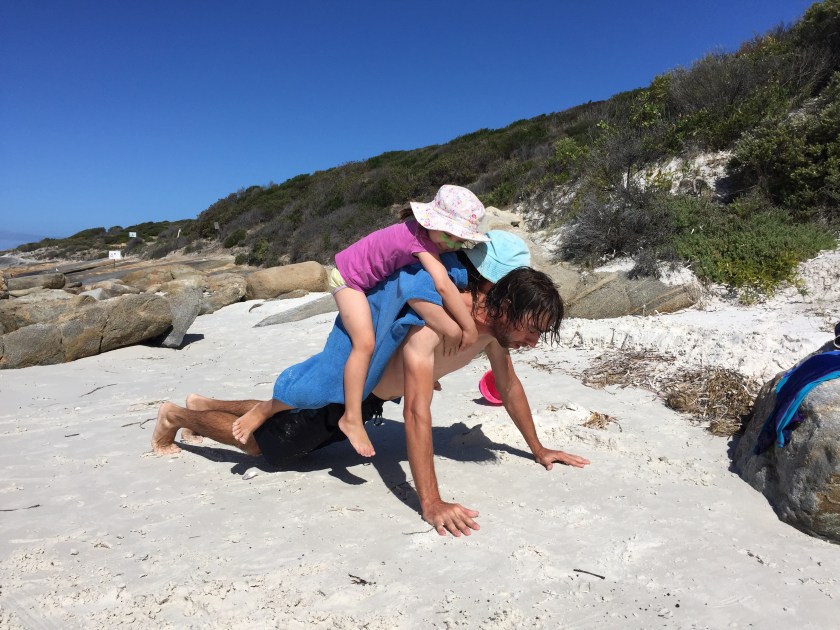
Playing in a rock pool in Cape Arid National ParkDad getting a bit of exercise on the beach
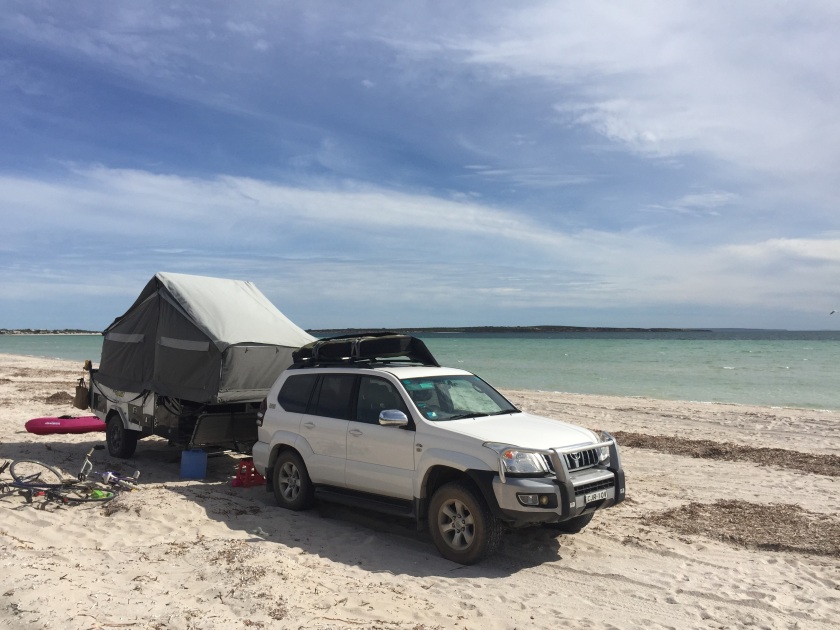
We stayed three nights in a beautifully laid-out campground, overlooking a long beach. Each site was surrounded by banksia trees; you could see and hear the roaring surf below. White sands, clear waters and granite boulders made up the coastal landscape. We went on a bushwalk to Dolphin Cove and saw half a dozen lizards of varying size and extreme speed. Back at the beach, girls made mermaids in the sand and K, Lee and I boogie-boarded.
In the evenings we had happy hour with the grey nomads. It gets dark early now, so we brought fairy lights into the camp kitchen, a shelter with a view of the ocean. I fed the girls dinner while the adults drank cask wine and talked about good roads and bad roads and getting bogged on the beach. The campers spoke of campsites on the Nullarbor with howling dingos.
And, as the evening wore on, they told stories of croc attacks up north and shark sightings down south, until finally we ambled back to our respective campsites to cook dinner and play the ukulele under the stars.
I’ve been hearing about the Nullarbor since I first came to Australia, nearly twenty years ago. The vast treeless plain got its name from the Latin—nullus (no) arbor (tree). Some people dread the drive; others cycle across the Nullarbor. I didn’t know what to expect.
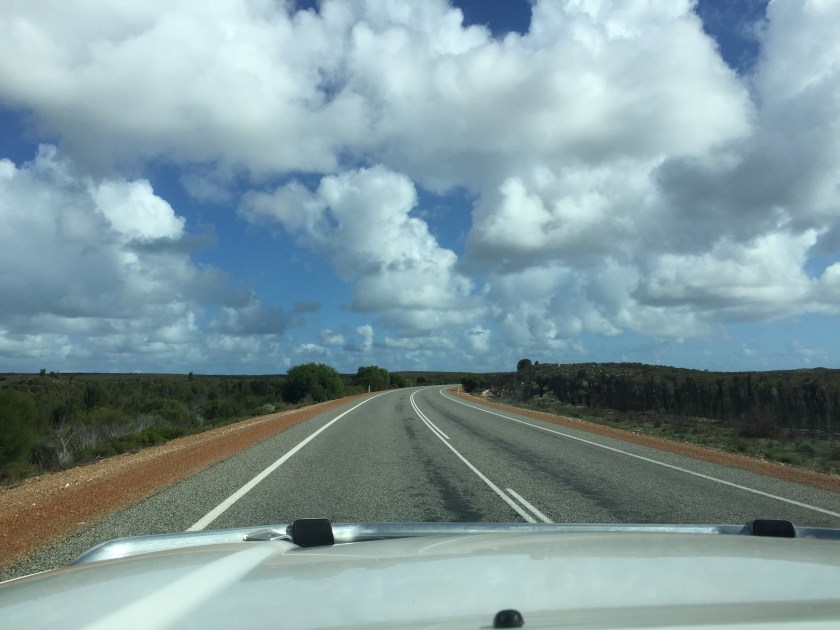
Then, there we were, last week—the four of us—driving across the Nullarbor. Scrub stretched out in all directions as we headed down a dead straight road: Highway One.
In the back seat K read Harry Potter for the sixth time. R drew endless maps. Lee drove, mostly, and I stared out the window at shades of green and brown. Occasionally a wedge-tailed eagle soared overhead, or came down to feast on dead kangaroo at the side of the road. And I had nothing to do except stare out the window and contemplate half a life gone by.
One of Murphy’s haystacksReading (and living) Are We There Yet?
Murphy’s Haystacks are large granite rocks protruding from a field that shine golden in the afternoon sun. They were made famous by the children’s book, Are We There Yet. The rocks are just off Flinders Highway on the west coast of the Eyre Peninsula. After a day of exploring, including the impressive Woolshed (ocean) Cave, we landed up at Murphy’s, which is just a parking area on a private sheep farm. The farmer humbly requests $2 per person/$5 per family to visit the boulders—inselbergs, millions of years old.
We decided to camp there for the night and Lee set up the tent while the girls clambered over the rocks, an odd beautiful sight in the middle of fields. The girls had the rocks to themselves, though a few grey nomads in caravans parked overnight along with us. I said to Lee, “If this were America, they’d put up a big fence, possibly a theme park, and charge a hundred dollars to take tours.”
As I was cooking dinner, the farmer himself came by, bucket and toilet brush in hand, to do his nightly clean of the loo. He introduced himself and explained we was a Cash—like Johnny—he smiled. His uncle was Murphy, but didn’t have children so Farmer Cash inherited the rocks. He was an amiable man, who’d grown up in the area, never moved and raised ten kids on the farm with his wife. One of his sons made it big in San Francisco. “His wife’s American,” the farmer told me, “and she’d like me to do something here, but,” and he shook his head and looked at me. “That would ruin the tranquility.” He smiled. And then he went off to clean the toilets.
That night we watched the sun set over the rocks and after the kids went to bed, Lee and I sat up looking for shooting stars.
The Eyre Peninsula continues to surprise and stun us with clear waters, beautiful beaches, rolling hills, friendly folk and abundant wildlife.
We spent four nights over Easter at Lincoln National Park, where the girls made friends, as kids easily do when camping.
Friends!
A generous family from Arno Bay took Lee on their motor boat, gave him some tips and he came home with fish and squid for tea.
Then we headed to Coffin Bay Caravan Park for much-needed showers. On the way I did a big shop at Wollies, our last major grocery store for about 1,800 Ks. Hopefully Lee will catch more fish!
Coffin Bay is a picturesque town, known for oysters. We had a dozen for $9.50. Yum.
We also camped around the corner at Coffin Bay National Park. From the kayak we saw several sting rays.
R and Joey contemplate one another at Coffin Bay National Park






 R among the tingles–Treetop Walk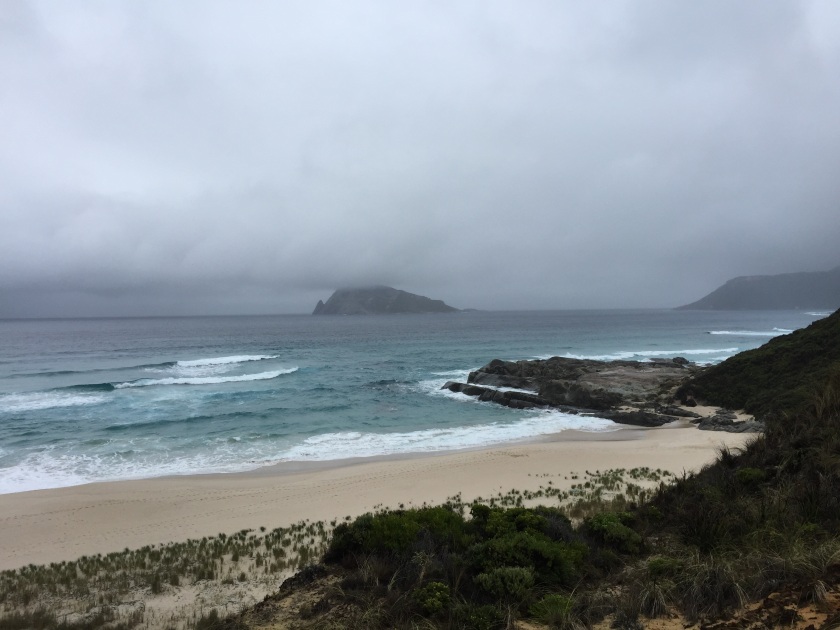









 handsacrossaustraliadotcom